|
| |
|
|
| |
Radiograph — A specially sensitized film that records the internal structures of the body by the passage of X-rays. An X-ray film.
Range of Motion — The range, measured in degrees of a circle, through which a joint can be extended and flexed.
Rare Earth Screens — A phosphorous coated panel placed next to X-ray film that glows when it is exposed to X-ray radiation, reducing exposures and enhancing the image.
Reflex — An involuntary action resulting from a stimulus.
Rehabilitative Care — A type of chiropractic care with the objective of strengthening the spine and providing optimum healing of the function of the spine, associated tissues, and organ systems.
Relief Care — See Initial Intensive Care.
Report of Findings — A short presentation, usually by the chiropractor, describing the patients problem, how long it will take to correct and the prognosis.
Sacrum — The triangular bone at the base of the spine.
Sciatica — A pain that radiates from the back into the buttocks and into the leg caused by the irritation of the sciatic nerve, the largest nerve in the body.
Scoliosis — A sideways curve of the spine as viewed from the back.
Slipped Disc — An incorrect name given a condition in which a disc becomes wedge-shaped and bulges. In extreme cases this pressure will cause a disc to rupture.
S.O.A.P notes — A system of patient record keeping based on the patients Subjective complaints, Objective complaints, Doctor's Assessment, and treatment Plan.
SOT — SOT stands for Sacro Occipital Technique, a method of normalizing the relationship between the foundation of the spine and the top of the spine by specifically positioning the body to use its weight to correct the body.
Spasm — A contraction of muscle tissue.
Spinous Process — A posterior protruding part of a spinal bone that can be seen or felt when examining the spine.
Spurring — A projecting body, as from a bone.
Subjective complaints — Those problems identified by the patient such as headaches, leg pain, etc.
Superior — Upper or higher in position.
Supine — Lying horizontal on the back with the face upward.
Technique — A specific procedure, method or maneuver used to correct spinal problems.
Therapy — Methods used to assist in the relief of pain, rehabilitation, and restoration of normal body functions.
Thoracic — Pertaining to the part of the spinal column from the base of the neck to about six inches above the waistline.
Traction — The act of drawing or exerting a pulling force, as along the long axis of a structure.
Transverse Process — Lateral protrusions (wings) of bone from the vertebrae to which powerful muscles attach.
Trigger Point — An involuntarily tight band of muscle that is painful when pressed and can cause referred pain in other parts of the body.
Ultrasound — High frequency inaudible sounds whose vibrations can be used for heating internal structures of the body.
Vertebra — Any of the individual bones of the spinal column.
Wellness care — Health care that is not prompted by sickness or injury but by an attempt to achieve or promote an optimum state of physical, mental and social well-being.
Whiplash — An injury to the cervical spine caused by an abrupt jerking motion of the head, either backward or forward.
X-rays — Electromagnetic energy that can penetrate many objects and reveal their internal structure by recording the shadow cast on photographic plates.
About Dr. Lu
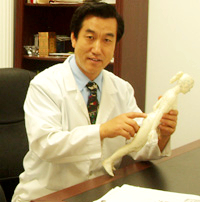
Dr. Lu completed his medical education and training in China. (The Chinese Academy of Medical Sciences and Shandong University Medical College respectively) Over 20 years clinic and research experiences in both medical school and hospital, Dr. Lu learned both West Medicine and Traditional Chinese Medicine including modern medical technology, acupuncture, medicinal herbs, and specializing in neurology. After years practice and accomplishments in China, Dr. Lu was invited as a visiting professor at the University of South Carolina, School of Medicine in 1991. After excellent achievements in research program funded by NIH and NSF, Dr. Lu decided to become a Doctor of Chiropractic in order to introduce the Traditional Chinese Medicine to the Western culture. Obtained Doctor Degree of Chiropractic from Parker College of Chiropractic, Dr. Lu became a licensed Doctor of Chiropractic and Board Permit in Acupuncture, then began his practice in Dallas Texas since then. Dr. Lu learned NAET and became a NAET Instructor in 2003 and 2014 respectively. In 2007 Dr. Lu was voted the best Acupuncturist in the City of Richardson by Living Magazine. In 2013, Dr. Lu was rated the Best Chiropractor in City of Plano. In 2014 advanced to America's Top Chiropractors specialized in Natural Medicine. |
|
|
|
Copyright of New Star Chiropractic, Acupuncture & Wellness Center, 2004~2021, Last Updated on: Thursday, Mach 25, 2021 1:34 PM |